The great weight loss plans

Quick fixes are devised as a way of drawing people in and are the easiest traps to fall into. Celebrity workout videos and promises that in two days time you’ll have the body of your lifetime are sometimes too tempting to pass on.

However, you have to ask yourself… how often does one of these ‘new regimes’ and new diet plans happen? It’s simply not possible that each week there’s a new scientific breakthrough or development.

In fact, after 13 years using the same system, Weight Watchers has completely overhauled its ‘points scheme’ saying that ‘more has become known about the science behind weight loss’… which isn’t exactly ideal for those who have been following the program for 13 years!

There were some unusual comparisons to be seen with the old Weight Watchers points program – a breakfast for example consisting of a croissant and butter had the same points value as a breakfast of toast, ham and eggs as long as it contained the same number of calories – however, now Weight Watchers has added a point to the croissant because of the difference in nutritional value. So, after 13 years, we’re now being told the old idea was wrong and this new idea is correct. It leaves a lot of people left wondering where all their time and energy went.

The important thing to remember, with all diets and regimes, is that they are asking you for a commitment – the results don’t simply come from doing nothing – and it’s this concept that should be taken away and worked on.

Good results don’t come from doing nothing whichever diet you choose to follow. However, if you applied this notion to your physical workout and showed the same kind of commitment there, then the results would probably be much greater and sooner. And remember… there are no fads with exercise, just time and commitment!


The Month of the Liquid Lunch

Well we are in the thick of the Christmas and New Year period – a month of partying and liquid lunching. It’s almost impossible to completely behave yourself during this period. Drinks with your boss, your colleagues, your partner’s boss and colleagues, your friends, your family… there’s almost not enough time for it all. And it’s extremely difficult to turn people down – especially when so many people are talking you into making an exception ‘just this once’… The pitfall is, that during Christmas and New Year, we don’t just make ‘one’ exception, we make the whole month an exception… and before we know it our bodies feel completely destroyed. It’s important to remember how easy it is to over-drink compared to over-eating… the intake of kilojoules in alcohol is reached extremely quickly. Just one long lunch time spent drinking and you could have taken in the recommended amount for a whole week. Even replacing alcohol with soft drinks can be dangerous. According to the National Soft Drink Association (NSDA) in America, since the late 70s the soft drink consumption in the United States has doubled for females and tripled for males. In fact, 21% of the sugar in the average American’s diet comes from soft drinks! An alarming statistic that is reflected in Australia through our astonishing obesity rates. For these people, cutting out this sugar alone could completely transform their entire bodies and health. As with every aspect of your life, your diet is about moderation and balance. Enjoy the Christmas period and allow yourself a few things that make you happy. Just remember how easy it is to over drink – and not just from the ‘being far too drunk’ perspective but from the kilojoules point of view. It takes an incredible amount of hard work to burn off excess kilojoule intake, so give yourself a present over Christmas – moderate and save yourself the extra work!

The Problems with Grazing

We’ve all heard about the benefits of eating small amounts of food, regularly – it keeps your metabolism rate high and doesn’t leave you with that bloated feeling. Controlled and well-balanced micro-meals are the key to a healthy lifestyle. By eating regularly, your insulin levels stay steady and you’re far less likely to feel those ‘crashes’.

However, for many, especially when stressed and out of the usual eating pattern, these controlled micro-meals turn into perpetual grazing – especially when under-sleeping.

It’s a common misconception that not getting enough sleep leads to weight loss. For some, yes, possibly this is true (in times of extremely high-stress). However, for most, less sleep simply means more time spent grazing and snacking.

The calories burnt by still being awake rather that asleep do not outweigh those gained by over-eating. It’s a simple matter of science. If your calorie intake is higher than what you are able to burn then you will put on weight. And for those that eat instead of sleep, this is far more likely!

The first step into tackling this is to look at your behavioural patterns. If you’re not sleeping or if you’re feeling painfully hungry in the middle of the night then your body has fallen into an unbalanced eating cycle. This could be due to stressful working days spent doing different tasks and not knowing when you have time for your next meal. For a lot of people, hectic working schedules are the biggest problem when it comes to trying to control their diet. Irregular eating patterns lead to irregular periods of hunger – and before you know it, you’re not sleeping and grazing instead.

Put time aside when you can to prepare your meals. If your days are extremely irregular prepare your meals and carry them with you. That way you’re not hunting for food and eating the wrong things due to your location and lack of choice. With these prepared meals you can then force yourself to set aside time in you schedule to stop and eat.

Do this each day at the same times and your body will start metabolising more regularly and your sleeping patterns will improve – then no more midnight snacking!

You are what you eat

Well, this is on we’ve heard over and over again… and unfortunately one that runs even deeper than just ‘junk food’. Most of us are well aware of the high fat content in certain greasy take-out foods, the high sugar levels in snacks and the danger of bad carbs…

However, what a lot of us don’t often think about are the carcinogenic impact of the WAY we cook foods like red meat.

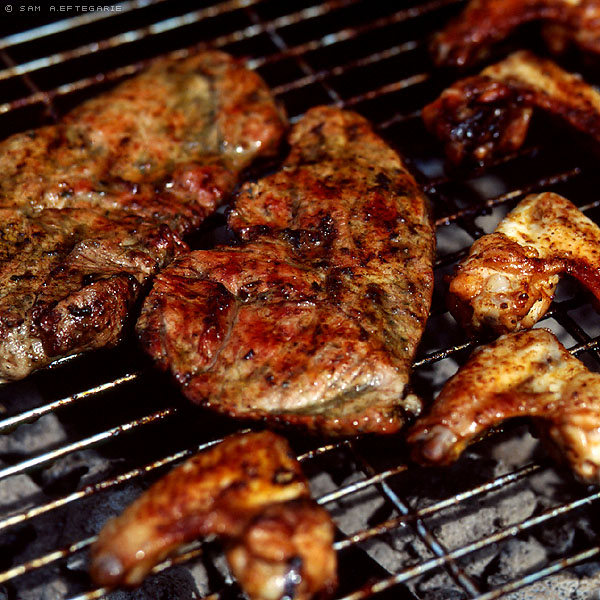
Red meat contains amino acids, sugars, and a protein called creatinine which, when cooked under high temperatures, is converted into a compound that is known to be carcinogenic for humans. With BBQ season quickly approaching, it’s wise to bear this in mind. Overcooking  meat (often and easily done when barbecuing) over time, can be extremely harmful to your body.

This isn’t to say you should add red meat to your list of things not to eat – far from it! Although it’s definitely wise to watch your intake (keeping it to2-3 servings per week), it’s also extremely good for other aspects of your health. If you’re still worried, then look into eating more Kangaroo meat. Kangaroo meat is possibly one of the healthiest meats on the market – it has been proven to help lower cholesterol and is only 2% fat. It is without a doubt one of the best meats around. Look into adding Kangaroo meat to your shopping and start by replacing one meal a week with it. As soon as you become accustomed to the introduction of a new meat into your diet you’ll do well to add more and more. Just remember, that whatever meat you’re eating, do not over cook and burn it. Not only will you lose a lot of the proteins and healthy aspects of the meat, you’ll turn these into very dangerous carcinogenics.

Diabetes – It’s Preventable!

An estimated 285 million people worldwide are living with diabetes – this corresponds to a shocking 6.4% of the world’s adult population.

About 90-95% of all people with diabetes have type 2 diabetes (the other being juvenile diabetes which cannot be prevented).

An incredible 80% of type 2 sufferers could have prevented this by changing diet, increasing physical activity and improving their general lifestyle.

It has been estimated that one person every seven minutes gets diagnosed with diabetes. The rate at which the condition is appearing in modern-day society is alarming – especially when you consider that type 2 can be prevented by the individual.

Almost a century ago diabetes wasn’t even a problem – and today it is one of the major killers. This is due to a dramatic change in modern day living, the fact that people eat foods high in carbohydrates, high in fat and do not exercise enough. The results of having a poor diet and fitness can go further than just the diabetes too – in extreme cases diabetes can lead to kidney disease, heart disease, high blood pressure, strokes, cataracts, nerve damage, hearing loss, and even blindness. 

Excess body weight is a very strong risk factor for type 2 diabetes and obviously diet plays a key role in the management of this and therefore the onset of the disease and its control. When it comes down to diet, this is all a matter of discipline and self control. It has never been more important than now to control what’s going into your body. Look at what’s happening on a global level, the rising statistics and the number of people who ‘suddenly’ discover that they have fallen into this bracket. So many people are living with diabetes without even knowing about it. Don’t be one of these people.

Look at your diet, adjust your lifestyle and live a healthy life. You are in control of what happens to your body.

Quick-fix food won’t fix anything

Your eating behaviours are a matter of personal choice – you have complete control over what goes into your body and therefore have complete control over how your body looks. However, it often isn’t that simple.

Years ago, the richest of people had the most succulent, fatty and delicious food to choose from – with a mass of disposable income, feasting on the very finest of food was an open display of wealth. Poorer people however, had less choice and were more than likely left to survive on a less varied, but extremely healthy diet, as the food would usually come straight from farming.

Fast-forward to today and this is almost the opposite way around. Although, as stated above, you have complete control over what you eat, for a large percentage of people, income still plays a major factor. However, with the rise of fast-food, meal-deals and microwave meals, the cheaper option is no longer the most natural one. The grains and fresh fruit that poorer people would once feast on have now been replaced by quick-fix unhealthy options, resulting in the majority of the nation getting fatter.

It’s these ‘money-saving’ solutions that are actually making the nation fatter. Cutting corners with your food is exactly the same as cutting corners with your exercise plan. There are ways to save and still eat well but like everything it takes time and self-discipline to do this. Cooking from fresh in large batches and saving meals for the next day, is a great way to save time and money if needs be.

Just don’t opt for the quick-fix option when it comes to food. There are no quick-fix solutions – this is the first and last thing you need to remember.

Scrap the diet and get some discipline

Discipline is the bridge between goals and accomplishment. To accomplish your fitness goals, what you need, before anything else, is the self belief and the will power to see yourself through to the end. Training is hard and achieving the perfect body and level of fitness is a fulltime commitment. Results don’t come over night, and even when they do come, it takes a massive amount of long-lasting commitment to see continued results. Fitness is a process which takes time and it most certainly doesn’t come without discipline.

The internet is full of fad diets and promises that you can lose weight by doing virtually nothing at all. But in reality this couldn’t be further from the truth. It’s not about starvation diets or tricking your body. It’s about continued discipline. The only way to lose weight and get fit is to stop with the excuses. Stop saying ‘I’m too tired’, ‘I’m too stressed’, ‘I don’t have the time’. Exercise is tough both mentally and physically. It’s a challenge on the entire body. Realising this, and making the effort to discipline yourself and push through, even when the results seem fleeting, is what will get you there in the end – nothing else.

Junk Foods – What our kids are missing out on!

Today I was talking to a Vision Personal Training client about the state of her pantry. She suggested that she had to have junk foods in her cupboard so her kids wouldn’t “miss out”. That comment stopped me in my tracks. The only thing I thought her kids were missing out on is the opportunity to feel healthy and energetic, as a result of eating healthy foods. After the meeting, I paused for a few moments and reflected upon how different people associate entirely different meanings to certain situations. The concept of missing out was interpreted in an entirely different way by me, compared to the way my client did.

With obesity rates in Australia reaching epidemic proportions, I think it about time society really started to view the consumption of junk food differently. The sooner that fast food companies are prevented from advertising during childrens TV programs and the sooner they are prevented from associating their products with kids toys the better.

Is that food really worth eating?

For many years now, I have been educating people about the impact that eating has on maintaining a healthy body shape. Society has become so time poor, impatient and inactive that I have witnessed people actually beeping their horns in McDonalds drive through ques. 

I have also witnessed many very active people absolutely flog themselves in exercise but remain out of shape. At Vision Personal Training, when we suggest that achieving a better body shape is 70% attributed to eating and only 30% to exercise, I dont think people really embrace this until they understand how much exercise it takes to burn up certain foods.

Below is a table extracted from my book “Fat Loss Take Control” which highlights the approximate amount of exercise needed to be done by a 70kg person to burn up certain foods. As most people really don’t like or make enough time to exercise but want to maintain their shape, this prompts  me to ask “Is that food really worth eating?”

Chinese, Sweet and Sour Pork, 1 cup Approx 62 mins aerobics
Bakers Delight, Finger Bun, 1 bun Approx 30 mins basketball
Boost Juice, Iced Coffee with no fat milk, 1 regular Approx 49 mins cycling
McDonalds, Double Cheeseburger, 1 burger Approx 60 mins hiking
Bisc& Mars, 1 biscuit Approx 30 mins swimming
The Cheesecake Shop, Boston Mudcake, 175g slice Approx 117 mins doubles tennis
Strawberry Daquiri, 1 cocktail Approx 36 mins golf
Fanta, 600ml bottle Approx 95 mins surfing
Killer Python, King Size Approx 70 mins yoga
Nestle/Peters, Heaven on a Stick, Cookies and Cream Approx 57.5 mins brisk walking

6 Tips to Take Control of your Eating Habits Forever

Completing an Eating and Exercise Diary is the best way to quickly understand your eating habits and what causes you to eat in such a way. Following are 6 ways to ensure that you use a diary effectively.

  1. [Read more…]